Working principle of globe valve?
I used to think all valves worked the same way—until a globe valve saved my system from sudden pressure damage.
The working principle of a globe valve is based on linear motion. A disc moves vertically to open or close the flow path by pressing against or lifting from a stationary seat. This structure allows precise flow regulation, making globe valves ideal for systems that require accurate throttling and tight shutoff.

You may think a valve is just a switch. But with globe valves1, the internal design changes how flow, pressure, and control really work.
What is the basic structure of a globe valve?
When I opened my first globe valve, I expected a simple gate. But the internal parts told a different story.
A globe valve has a spherical body, a movable plug or disc, a stationary seat, and a stem connected to a handwheel or actuator.
Key Components of a Globe Valve
| Part | Function |
|---|---|
| Body | Holds internal parts and fluid pressure |
| Bonnet | Covers the top and holds stem and packing |
| Stem | Moves the disc up or down |
| Disc (Plug) | Blocks or allows flow |
| Seat | Surface where disc seals flow |
| Handwheel | Manual control for opening/closing |
I remember replacing a damaged stem once. It made me realize how each part plays a role in maintaining steady flow.
How does the globe valve control fluid flow?
I thought turning the handwheel just opened or closed it. But I learned the control is more precise.
The stem raises or lowers the disc, changing the size of the gap between the disc and the seat, which adjusts how much fluid passes through.
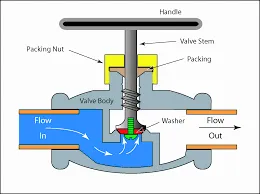
Flow Control Through Linear Motion
1. Flow Path and Pressure Drop
| Position | Flow Rate | Pressure Drop |
|---|---|---|
| Fully Open | Maximum | Moderate |
| Half Open | Controlled | Higher |
| Fully Closed | Zero | Maximum (sealed) |
2. Why It Works Well
The globe valve’s linear motion means I can fine-tune the flow, which helps when I need to maintain steady pressure in irrigation systems or chemical dosing setups.
What are the types of globe valve designs2?
I once assumed all globe valves were the same inside. But I discovered there are different flow patterns.
There are three main designs: Tee-pattern (Z-type), Angle-pattern, and Wye-pattern (Y-type), each offering different flow characteristics and applications.
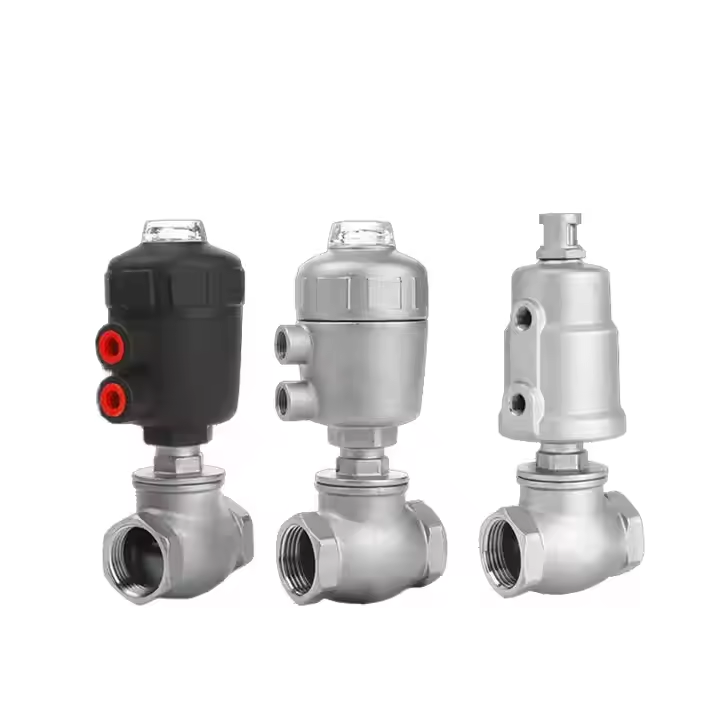
Comparing Globe Valve Designs
| Type | Flow Path | Resistance | Use Case |
|---|---|---|---|
| Z-Type | Straight in, 90° turn | High | General-purpose throttling |
| Y-Type | Diagonal seat | Moderate | Frequent operation |
| Angle-Type | 90° outlet angle | Low | Compact piping layout |
I once used an angle valve in a tight corner of a greenhouse system. It fit perfectly and reduced the pressure loss I had with a Z-type before.
Where are globe valves used?
I first saw globe valves on a steam line. But now I use them even in my irrigation control stations.
Globe valves are used in water supply, chemical plants, HVAC systems, and irrigation networks where flow regulation and frequent operation are needed.

Typical Application Fields
1. By Industry
| Industry | Globe Valve Role |
|---|---|
| HVAC | Control chilled water or steam |
| Chemical Plants | Handle corrosive or high-pressure fluids |
| Water Systems | Regulate municipal or irrigation flow |
2. Why I Prefer Them in Agriculture
I prefer globe valves for my fertilizer injection points. They help me adjust flow gradually without pressure shocks or leaks.
What are the pros and cons of globe valves?
I trusted globe valves for control, but I had to learn when not to use them.
Globe valves offer good throttling and sealing but come with higher pressure loss and more turning force compared to gate or ball valves.
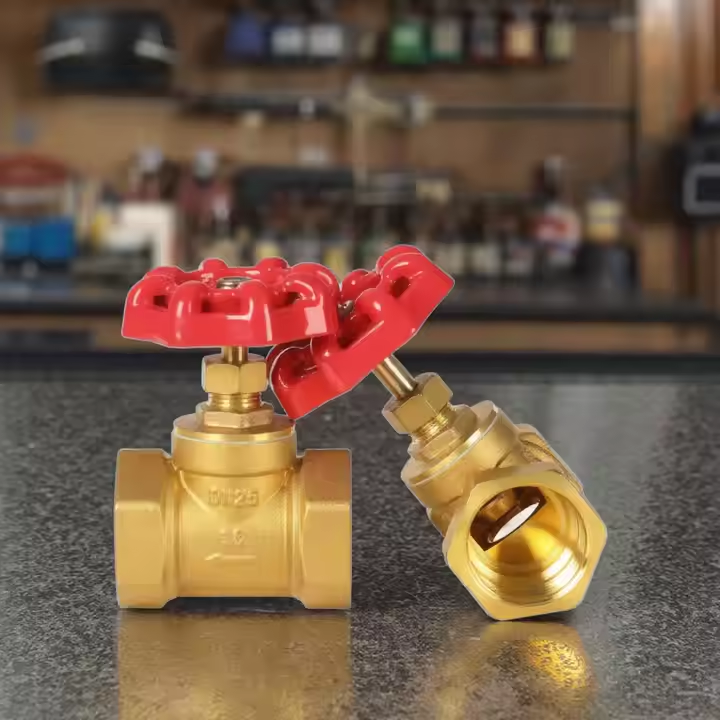
Evaluating Globe Valve Performance
| Feature | Advantage | Disadvantage |
|---|---|---|
| Flow Control | Very accurate | Pressure drop is higher |
| Shutoff Ability | Excellent sealing | Not ideal for full open flow |
| Maintenance | Easy to repair | Slower to operate manually |
I learned the hard way that globe valves are not for high-volume supply lines. But for control lines, they work better than anything else I’ve tried.
My insights
I used to ignore valve choice. But globe valves showed me that the right valve doesn’t just open or close—it manages your whole system.
If you care about flow control3, safety, and easy maintenance, the globe valve is a reliable tool in any system, from farming to factories.

I always check my system's needs before choosing a valve now. That one habit has saved me from costly repairs and downtime.
Conclusion
A globe valve controls flow by lifting a disc over a seat. Its simple but powerful design makes it ideal for precise regulation and reliable sealing.
Explore the advantages of globe valves in fluid control systems, including their precision and reliability, to enhance your understanding of their applications. ↩
Discover the various globe valve designs and their specific applications to choose the right one for your needs. ↩
Learn about the mechanisms of flow control in globe valves to understand how they can optimize your fluid management systems. ↩