What is PEX pipe, and why has it become a common alternative to rigid metal and plastic piping? Buyers often struggle to compare unfamiliar PEX grades, connection systems, and temperature ratings. A poor specification can cause premature failure or installation delays. I use this guide to explain how PEX works and how to evaluate it responsibly.
PEX pipe is a flexible plastic pipe made from cross-linked polyethylene. The cross-linking process improves its resistance to heat, pressure, cracking, and chemical degradation. Contractors commonly use PEX for indoor hot and cold water distribution, radiant floor heating, solar thermal systems, and selected industrial applications, subject to the manufacturer’s verified ratings.
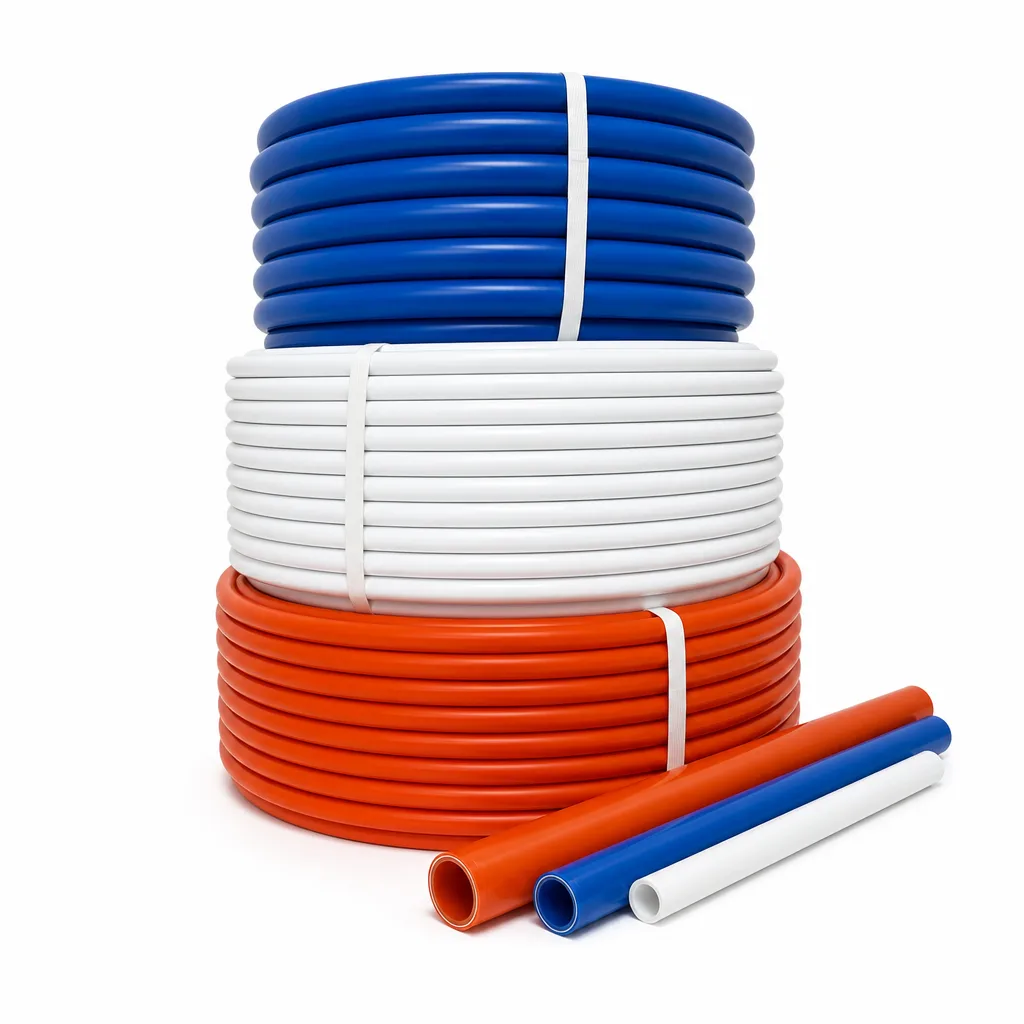
PEX looks simple from the outside, but product performance depends on more than color or wall thickness. I recommend looking closely at the cross-linking method, applicable standards, pressure-temperature rating, oxygen barrier, fittings, and supplier quality controls before placing a commercial order.
What Is PEX Pipe and How Is It Manufactured?
A polyethylene tube can lose strength when temperature and internal pressure rise. That weakness limits the use of ordinary polyethylene in hot-water installations. Manufacturers address the problem by creating molecular links within the material, but different cross-linking methods can affect flexibility, consistency, and purchasing decisions.
PEX, or cross-linked polyethylene, is a thermoset piping material produced by bonding polyethylene molecular chains into a three-dimensional network. This structure helps the tube retain mechanical strength under heat and pressure. Buyers may encounter PEX-a, PEX-b, and PEX-c, which identify manufacturing methods rather than simple quality grades.1
What Does “Cross-Linked” Mean?
When buyers ask me, “What is PEX tubing?” I usually begin with its molecular structure. Standard polyethylene consists of long polymer chains. Those chains can move relative to one another when heat or stress is applied. Cross-linking creates bonds between the chains, so the resulting network resists deformation more effectively.
This treatment gives PEX several useful characteristics:
- Flexibility for routing around obstacles
- Temperature resistance for many hot-water applications
- Pressure resistance when used within its rated operating envelope
- Resistance to corrosion and scale
- Improved crack resistance compared with non-cross-linked polyethylene
- Shape memory, especially in some PEX-a products2
PEX may remain physically stable across a broad temperature range, often cited as approximately -40°C to 95°C for suitable products. However, I do not treat this broad material range as a universal working-pressure approval. A pipe that tolerates a certain temperature does not necessarily maintain its full pressure rating at that temperature.
Pressure capacity generally decreases as temperature rises. Buyers should therefore verify the actual pressure-temperature table on the manufacturer’s technical data sheet. Common North American reference points may include ratings around 160 psi at 23°C, 100 psi at 82°C, and 80 psi at 93°C3, but exact values depend on the standard, dimension, and certified product.
Which Standards Should Buyers Check?
I recommend asking suppliers which standards govern their products. Relevant documents can include:
- ASTM F876 for PEX tubing4
- ASTM F877 for PEX hot- and cold-water distribution systems
- ISO 15875 for cross-linked polyethylene piping systems
- CSA B137.5 for PEX tubing systems in Canada
- NSF/ANSI/CAN 61 for drinking-water contact requirements
- NSF/ANSI 14 for plastic piping system components
A certificate alone does not prove that every shipment matches the tested product. I ask buyers to verify the certificate number, issuing body, product scope, size range, and validity. Project engineers should also confirm local plumbing codes because permitted applications and connection methods vary by jurisdiction.
What Are the Main Types of PEX Pipe?
The labels PEX-a, PEX-b, and PEX-c often create unnecessary confusion. Some buyers assume that “a” automatically means first quality and “c” means third quality. That interpretation is incorrect. I compare the manufacturing process, flexibility, dimensions, certification, and intended connection system instead.
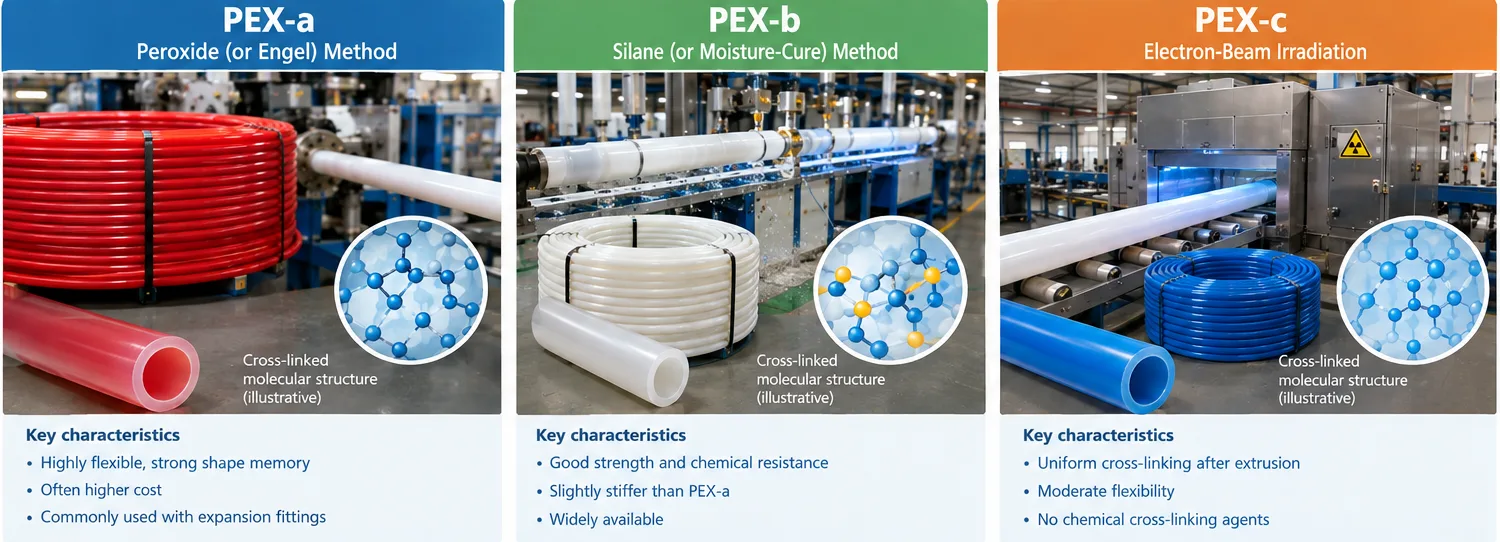
The three principal types of PEX pipe are PEX-a, PEX-b, and PEX-c. PEX-a uses the peroxide method, PEX-b typically uses the silane or moisture-cure method, and PEX-c uses electron-beam irradiation. Each method produces compliant tubing when the manufacturer controls raw materials, dimensions, cross-linking, and testing properly.
How Do PEX-a, PEX-b, and PEX-c Compare?
The following table summarizes practical procurement differences. These are general tendencies rather than guaranteed performance levels.
| PEX type | Cross-linking method | Typical characteristics | Procurement considerations |
|---|---|---|---|
| PEX-a | Peroxide or Engel process | Usually highly flexible with strong shape memory | Often costs more; commonly paired with expansion fittings |
| PEX-b | Silane or moisture-cure process | Good strength and chemical resistance; often slightly stiffer | Widely available; buyers should verify cure consistency |
| PEX-c | Electron-beam irradiation | Uniformly irradiated after extrusion; moderate flexibility | Availability varies; kink recovery may be more limited |
| PEX-AL-PEX | PEX layers with an aluminum core | Holds its formed shape and reduces thermal expansion | Requires compatible fittings and careful layer-quality inspection |
PEX-a is commonly cross-linked during extrusion. Its flexibility can simplify tight routing, and some approved products can recover from a kink when treated according to the manufacturer’s instructions. Buyers should never apply uncontrolled flame or excessive heat to make repairs.
PEX-b is usually extruded first and then cross-linked through a silane-assisted moisture-curing process. It can deliver reliable performance, but production control matters. I would ask a supplier how it monitors cross-linking levels, curing time, wall thickness, and lot traceability.
PEX-c is cross-linked through high-energy electron irradiation after extrusion. The process avoids chemical cross-linking agents. However, the finished tube may not offer the same degree of flexibility or thermal kink recovery as some PEX-a products.
Do Colors Identify Different PEX Grades?
Red, blue, white, and other colors usually help installers identify service lines. They do not automatically indicate a different pressure rating or material grade.
- Red commonly identifies hot-water service.
- Blue commonly identifies cold-water service.
- White or natural tubing may be used for either service.
- Orange tubing often appears in radiant heating applications.
- Barrier-marked tubing may contain an oxygen-diffusion layer.
I once saw a purchasing team compare two coils based mainly on color and unit price. The more important difference was that one product had an oxygen barrier and the other did not. I now treat printed markings and technical documentation as more reliable than visual appearance.
What Are the Most Common PEX Pipe Uses?
Choosing a familiar material for the wrong service creates risk. PEX performs well in many indoor fluid systems, but it is not a universal replacement for every pipe. Sunlight, chemicals, pressure, temperature, local codes, and connection accessibility can all change the decision.
Common PEX pipe uses include indoor potable-water distribution, radiant floor heating, hydronic heating, snow-melting loops, selected solar thermal circuits, and renovation plumbing. Its long coil lengths and flexible body reduce the number of directional fittings, but every application must remain within the verified chemical, pressure, temperature, and code limits.
Potable Hot and Cold Water
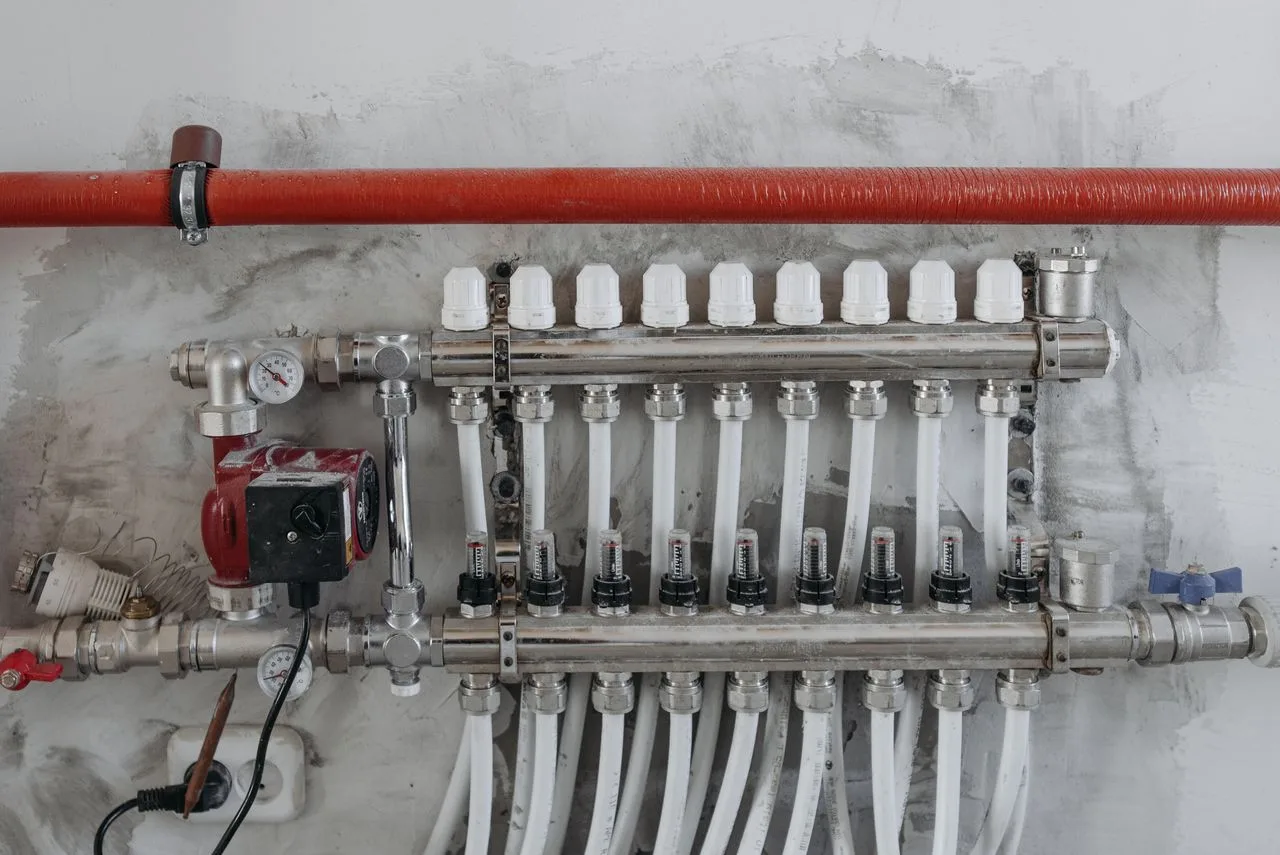
PEX is widely used for branch-and-trunk plumbing and manifold distribution. A manifold system can give each fixture a dedicated line, which may reduce hidden joints and simplify isolation. Long coils also allow installers to create gradual bends instead of using an elbow at every change in direction.
For potable-water projects, I recommend confirming:
- The pipe has the required drinking-water approval.
- The fittings and valves carry compatible approvals.
- The pipe size supports the required flow rate.
- The operating pressure remains within the derated limit.
- The installation follows local code requirements.
Radiant Floor and Hydronic Heating
PEX is particularly suitable for radiant floor loops because it is flexible and available in long lengths. Installers can embed continuous circuits in or below a floor with relatively few joints.
Systems containing ferrous pumps, boilers, or radiators may require oxygen-barrier PEX. The barrier limits oxygen diffusion through the pipe wall. Without an appropriate barrier or system separation, dissolved oxygen can contribute to corrosion in metal components.
Loop length and spacing also affect performance. Common tube spacing may range from roughly 150 to 300 mm, while practical circuit lengths depend on tube diameter, pump capacity, heat loss, and acceptable pressure drop. A qualified heating designer should calculate these values rather than rely on a generic layout.
Renovation and Retrofit Plumbing
PEX can be valuable in older buildings because installers can route it through joist spaces, wall cavities, and existing openings. Its flexibility may reduce demolition compared with rigid piping. This benefit is especially useful when labor and surface restoration cost more than the pipe itself.
However, installers still need to protect tubing from:
- Nails and screws near framing penetrations
- Abrasive contact with sharp metal edges
- Excessive bend stress
- Unsupported sagging
- High-temperature flues and heat sources
- Prolonged ultraviolet exposure
Solar and Specialized Systems
Some manufacturers approve specific PEX products for parts of solar hot-water systems. Yet stagnation temperatures in solar collectors can exceed normal domestic hot-water conditions. I would never assume that standard plumbing PEX is suitable throughout an entire solar circuit.
PEX is also not automatically suitable for compressed air, fuel gas, concentrated chemicals, or high-purity industrial fluids. Project engineers should review chemical compatibility and applicable regulations before selecting it for a specialized service.
What Are the PEX Pipe Advantages and Disadvantages?
Marketing descriptions often focus on flexibility and fast installation while giving less attention to UV sensitivity, fitting compatibility, or thermal expansion. That imbalance can create costly surprises. I prefer to assess PEX pipe advantages and disadvantages together, based on the complete installed system rather than tube price alone.
PEX pipe offers corrosion resistance, flexible routing, quiet operation, and fewer directional joints than rigid piping. Its disadvantages include sensitivity to prolonged sunlight, application-specific temperature limits, thermal expansion, and dependence on compatible fittings and tools. The final performance depends heavily on product certification, system design, workmanship, and storage conditions.

Main Advantages
1. PEX does not rust.
The polymer does not experience electrochemical corrosion like steel. It also avoids the green corrosion products associated with some copper installations.
2. Flexible coils can reduce fittings.
A gradual bend may replace several rigid elbows. Fewer joints can mean fewer potential leak points, although each remaining connection must still be installed correctly.
3. PEX can simplify retrofits.
Installers can often route it through existing structures with less cutting. The benefit can lower total labor and restoration costs.
4. The material tolerates some freezing expansion.
PEX often withstands temporary freezing better than many rigid pipes.5 However, it is not freeze-proof. Fittings can fail, and repeated freeze-thaw cycles can damage the system.
5. The smooth bore limits scale accumulation.
Its internal surface supports efficient flow and does not corrode into the waterway.
6. PEX can reduce water-flow noise.
Its flexibility helps absorb pressure fluctuations and vibration compared with some rigid metal systems.
Main Disadvantages
1. Ultraviolet light can degrade PEX.
PEX should not remain outdoors or in direct sunlight beyond the manufacturer’s stated exposure allowance. UV damage may occur even before installation, so covered storage is important.
2. Temperature limits require careful checking.
The pipe loses pressure capacity as water temperature rises. Buyers need a full pressure-temperature rating, not just a maximum temperature in a brochure.
3. Thermal expansion can be significant.
PEX generally expands and contracts more than metal pipe.6 Installers need correct supports, allowances, and routing methods.
4. Fitting systems are not universally interchangeable.
Expansion, crimp, clamp, press, and push-fit connections have different requirements. A tube may comply with a broad standard but still need specifically approved fittings.
5. Rodent damage can occur.
PEX is not a food source, but rodents may chew it when it blocks a pathway. Physical protection and pest control may be necessary in vulnerable areas.
6. Recycling can be difficult.
The cross-linked structure improves heat resistance, but it also prevents conventional remelting. Recycling options are more limited than for thermoplastic materials such as standard polyethylene or polypropylene.
I evaluate the pipe, fitting, tool, and installation procedure as one system. A high-quality tube cannot compensate for an incompatible fitting or an incorrectly calibrated tool.
How Do PEX vs PVC Pipe and PEX Pipe Fittings Compare?
Buyers sometimes compare PEX and PVC only by price per meter. That comparison misses important differences in temperature capability, flexibility, joining methods, and typical service. A low material price can become expensive if the product requires more fittings, labor, supports, or code approvals.
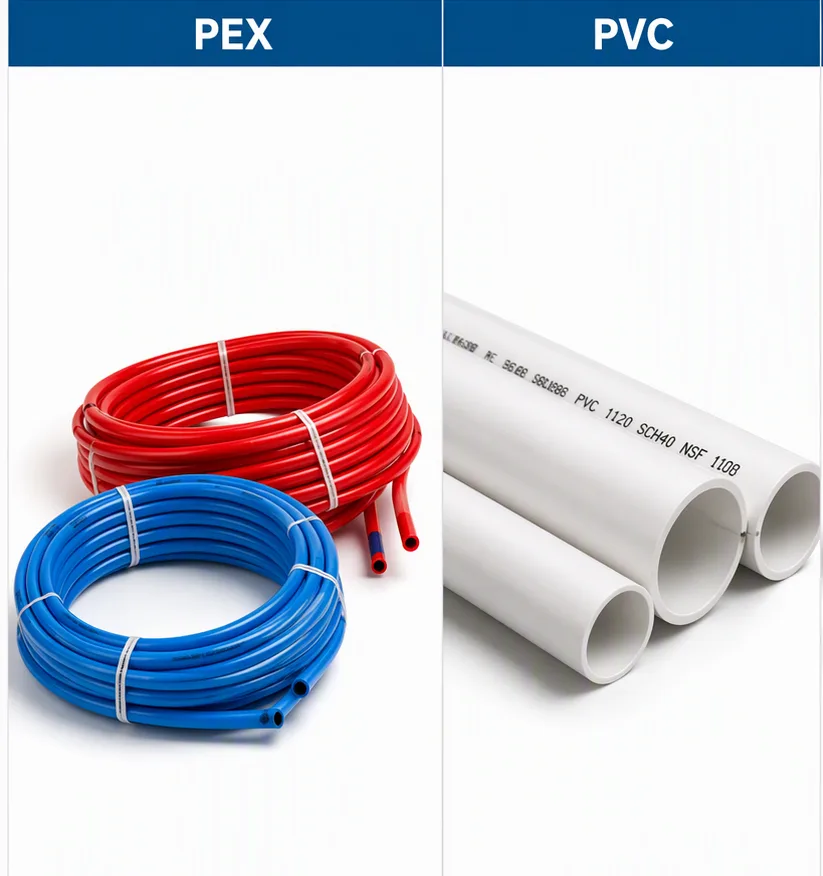
In a PEX vs PVC pipe comparison, PEX is generally better suited to flexible indoor hot- and cold-water distribution, while PVC is commonly selected for rigid cold-water, drainage, irrigation, and industrial piping. CPVC may handle hot water where approved. Buyers should compare the exact material grade and complete system cost.
PEX vs PVC Pipe
| Factor | PEX | PVC | CPVC |
|---|---|---|---|
| Form | Flexible coils or straight lengths | Rigid lengths | Rigid lengths |
| Typical service | Indoor water and radiant heating | Cold water, irrigation, drainage, industrial service | Hot and cold water, selected chemical service |
| Joining | Crimp, clamp, expansion, press, or approved push-fit | Solvent cement or mechanical connections | Compatible solvent cement or mechanical connections |
| Corrosion | Resistant | Resistant | Resistant |
| UV resistance | Generally limited | Formulation-dependent; protection may be required | Generally requires protection |
| Thermal expansion | Relatively high | Lower than PEX but still relevant | Requires design allowance |
| Direction changes | Can bend gradually | Usually requires fittings | Usually requires fittings |
| Hot-water suitability | Common when rated | Standard PVC is generally unsuitable | Common when rated |
The right choice depends on the project. PEX may reduce labor in indoor distribution networks, while rigid PVC can be more practical for irrigation mains and many cold-fluid systems. CPVC can serve higher-temperature applications while preserving rigid alignment.
Chemical compatibility also matters. PEX resists many water-treatment conditions, but certain oxidants, hydrocarbons, and aggressive chemicals may affect it. PVC, CPVC, PP, PPH, and PVDF each have different chemical resistance profiles. I recommend a documented compatibility review for industrial fluids.
How Should Buyers Select PEX Pipe Fittings?
Common PEX pipe fittings include:
- Crimp fittings used with copper or stainless crimp rings
- Clamp fittings used with stainless cinch clamps
- Cold-expansion fittings that rely on the tube’s shape recovery
- Press fittings installed with approved powered or manual tools
- Push-fit fittings designed for specified tube dimensions
- Manifolds and transition adapters for connection to other piping materials
A fitting should match the pipe’s outside diameter, wall specification, connection standard, and application approval. I also check the fitting material. Brass, engineered polymer, and stainless steel fittings can all be appropriate, but water chemistry and dezincification risk may influence the choice.
For supplier evaluation, I request:
- Current product and potable-water certifications
- Dimensional inspection records
- Hydrostatic or pressure-test information
- Cross-linking test results
- Raw-material traceability
- Production-lot identification
- UV-resistant storage and packaging details
- Samples for fitting and pressure validation
- Warranty terms and claim procedures
Our experience with plastic valves and pipeline components has taught me that interface control is essential. Buyers should test the proposed pipe, valves, manifolds, adapters, and fittings together before approving a large shipment. A qualified engineer or plumbing professional should make the final selection for project-specific conditions.
Frequently Asked Questions
Can PEX pipe be used outdoors?
PEX should not be used in prolonged direct sunlight unless the manufacturer specifically approves and protects the application. Ultraviolet radiation can damage the polymer and shorten service life. I recommend covered storage, protected routing, and verification of the manufacturer’s maximum permitted UV exposure before installation.
Is PEX safe for drinking water?
Certified PEX can be suitable for potable water. Buyers should verify compliance with relevant drinking-water standards, such as NSF/ANSI/CAN 61 where applicable. They should also confirm that the fittings, valves, and joining materials carry the necessary approvals for the local market.
What is the difference between PEX pipe and PEX tubing?
The terms are often used interchangeably in plumbing. “Tubing” commonly refers to products identified by controlled outside diameter, while “pipe” may be associated with nominal sizing conventions. I recommend using the dimensions and standards printed on the product rather than relying on the wording alone.
How long can PEX pipe last?
Manufacturers often design approved PEX systems for decades of service, but no single lifespan applies to every installation. Temperature, pressure, water chemistry, UV exposure, fitting quality, and workmanship all affect durability. Buyers should review certified test data and warranty conditions rather than rely on a general lifespan claim.
Can PEX connect directly to PVC valves and pipe?
PEX can connect to PVC systems through a compatible transition fitting or threaded adapter. Installers should avoid excessive stress, unsupported weight, and overtightening at plastic threads. I recommend checking pressure ratings and using an approved transition arrangement designed for both materials.
Conclusion
PEX pipe is a flexible, cross-linked polyethylene product used mainly for indoor water distribution, radiant heating, and renovation work. Its corrosion resistance and easy routing can reduce installation complexity, but UV exposure, temperature derating, thermal expansion, and fitting compatibility require careful control. I recommend comparing standards, test records, pressure ratings, and complete system compatibility before purchasing. Contact us to discuss compatible plastic valves, pipe fittings, OEM components, and material options for your fluid-handling project.
"Cross-linked polyethylene", https://en.wikipedia.org/wiki/Cross-linked_polyethylene. Technical references distinguish PEX-a, PEX-b, and PEX-c by peroxide, silane-assisted, and irradiation-based cross-linking processes, respectively; these letters identify production methods and do not by themselves constitute a quality ranking. Evidence role: definition; source type: education. Supports: Technical references classify PEX types by the process used to cross-link polyethylene, rather than by an ordinal quality ranking.. ↩
"Shape Memory Behavior of Carbon Black-reinforced Trans-1 ...", https://pmc.ncbi.nlm.nih.gov/articles/PMC6572694/. Studies of cross-linked polyethylene report thermally activated shape recovery arising from the polymer network's elastic memory; in piping, usable kink recovery depends on the formulation and the manufacturer's prescribed procedure. Evidence role: mechanism; source type: paper. Supports: Cross-linked polyethylene networks can recover toward a previously established shape after deformation under appropriate thermal conditions.. Scope note: General shape-memory research does not prove that every PEX-a tube may be repaired after kinking or that field heating is always permitted. ↩
"Apollo PEX-B Pipe", https://apolloflow.com/apollo-pex-b-pipe/. North American PEX specifications commonly identify pressure ratings of 160 psi at 73°F, 100 psi at 180°F, and 80 psi at 200°F for qualifying tubing; actual approval remains dependent on the product's standard designation and certification. Evidence role: statistic; source type: institution. Supports: North American PEX standards and certification materials specify standardized pressure ratings at defined temperatures for qualifying tubing.. Scope note: The reference values do not establish that every size, construction, or branded product carries all three ratings. ↩
"Standard Specification for Crosslinked Polyethylene (PEX) ...", https://store.astm.org/f0876-26.html. ASTM F876 is the standard specification for cross-linked polyethylene tubing and establishes applicable dimensional, material, and performance requirements within its stated scope. Evidence role: definition; source type: institution. Supports: The official ASTM scope identifies F876 as a specification governing cross-linked polyethylene tubing and associated performance and dimensional requirements.. Scope note: Compliance with ASTM F876 alone does not establish code acceptance, potable-water approval, or compatibility with a particular fitting system. ↩
"Cross-linked polyethylene", https://en.wikipedia.org/wiki/Cross-linked_polyethylene. Controlled freezing studies indicate that flexible PEX tubing can accommodate limited ice expansion more effectively than some rigid piping materials under comparable conditions. Evidence role: general_support; source type: research. Supports: Experimental evidence should show that the flexibility and strain capacity of PEX can allow it to accommodate some ice expansion better than selected rigid pipes.. Scope note: This comparative tolerance does not make a PEX system freeze-proof; fittings, constrained sections, and repeated freeze-thaw cycles may still fail. ↩
"La. Admin. Code tit. 51, § XIV-619 - Water Distribution Pipe ...", https://www.law.cornell.edu/regulations/louisiana/La-Admin-Code-tit-51-SS-XIV-619. Engineering property tables report a substantially higher coefficient of linear thermal expansion for cross-linked polyethylene than for copper or steel, supporting the need for movement allowances and appropriate supports. Evidence role: statistic; source type: education. Supports: Engineering property data should show that cross-linked polyethylene has a substantially higher linear thermal-expansion coefficient than copper or steel.. Scope note: The exact coefficient varies with temperature, formulation, reinforcement, and test method. ↩