A flange is a type of PVC pipe fitting used to connect pipes to valves, pumps, or other pipe components. Unlike standard pipe fittings, flanges use bolted connections, allowing for easy disassembly for maintenance or system modifications.
The primary advantage of a flange is its serviceability: it allows for easy disassembly of the piping system for maintenance, cleaning, or reconfiguration without cutting the pipes.
Essential PVC Flange Types
PVC flanges are categorized by how they attach to the pipe and how the bolt holes are aligned.
1. One-Piece Flange (Solid Flange)
In this design, the hub (where the pipe attaches) and the flange ring (where the bolts go) are a single molded unit.
- Best For: Simple, permanent installations
- Note: Because it is solid, the bolt holes are fixed. You must ensure perfect alignment before the glue sets.

PVC TS Flange
2. Van Stone Flange (Two-Piece Flange)
The Van Stone flange1 consists of a central hub and a separate, rotating outer ring.
- Best For: Most industrial and commercial applications
- Advantage: The hub is glued first, and the outer ring can rotate freely to perfectly match bolt holes, preventing bolt-hole misalignment stress.
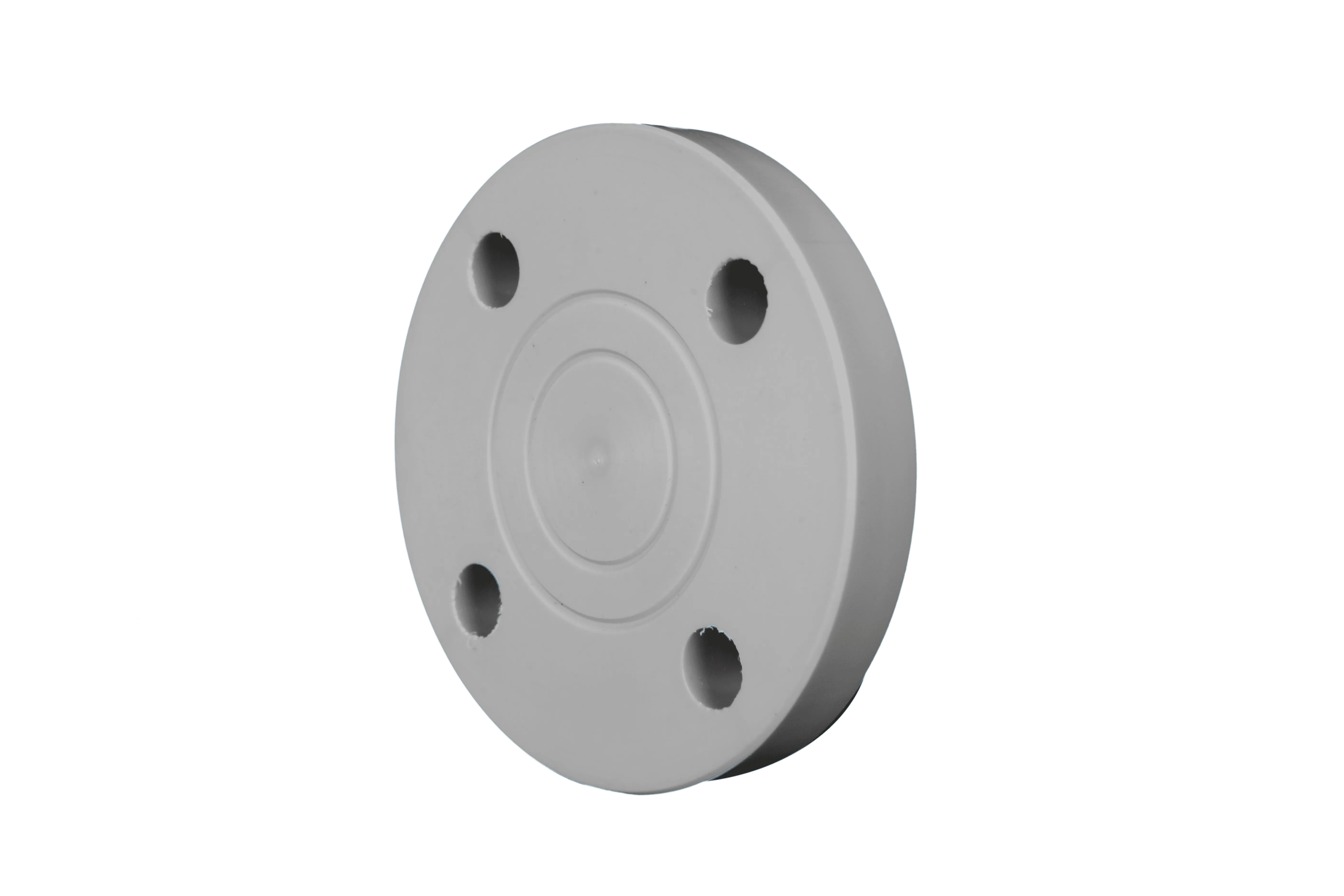
3. Blind Flange
A blind flange is a solid disc with no center opening.
- Best For: Terminating a pipe run or sealing off a bypass
- Advantage: Acts as a removable cap, allowing for future system expansion.
4. Threaded Flange
The interior of the hub is equipped with female threads (NPT or BSP) rather than a smooth socket.
- Best For: Transitioning from metal pipe to PVC or when solvent welding is not permitted
5. Slip Flange (Socket Flange)
The most common industrial type. The pipe slips into the socket and is permanently fused using PVC solvent cement.

What Standards Apply to PVC Flanges?
To ensure compatibility between PVC flanges and metal valves or pumps from different manufacturers, industry standards are strictly followed.
1. Dimensional Standards (Bolt Patterns)
These standards ensure bolt holes align across materials:
- ANSI / ASME B16.5 – North American standard (commonly Class 150)
- DIN / EN 1092-1 – European metric standard (PN10 / PN16)
JIS – Japanese Industrial Standard (e.g., 10K)
⚠️ Some sizes of ANSI and DIN standard flanges have oval-shaped bolt holes, making them interchangeable.
PVC Flange Standards and PN10 Pressure Ratings
To ensure global compatibility and safety, a PVC Flange must adhere to specific industrial standards. These standards dictate the dimensions, bolt patterns, and pressure-bearing capabilities of the fitting:
Dimensional Standards: Most North American projects utilize the ANSI Class 150 bolt pattern. However, for European or Asian infrastructure, the DIN 8063 (PN10/PN16) standard is widely used to ensure precise fitting with metric equipment.
PN10 Systems: For medium-pressure applications, uPVC PN10 pipes and fittings are the industry standard. These systems are designed with a nominal pressure rating of 10 bar (approximately 145 PSI) at room temperature.
Schedule 40 Applications: For residential plumbing, irrigation, and lower-pressure industrial lines, Schedule 40 PVC pipe fittings are frequently used due to their cost-effectiveness and versatility.
Material Quality: High-quality flanges are manufactured using 100% virgin unplasticized PVC (uPVC). Using materials free from recycled additives ensures superior long-term chemical resistance and prevents structural brittleness.
3. Pressure & Temperature Ratings
- Pressure: Typically rated 150 PSI at 73°F (23°C)
- Temperature: Maximum service temperature 140°F (60°C)
As temperature increases, the pressure rating of PVC flanges decreases significantly.
Installation & Torque Specifications
Proper installation is essential to prevent cracking or long-term stress failure.
Bolt Tightening Sequence
Bolts must be tightened in a star (criss-cross) pattern to evenly compress the gasket. Tightening one side fully before others often causes flange failure.
Recommended Torque Values (Schedule 80)
Applies to lubricated bolts using a full-face EPDM gasket.
| Pipe Size | Bolt Diameter | Number of Bolts | Recommended Torque (Ft-Lbs) |
|---|---|---|---|
| 2" | 5/8" | 4 | 20 – 30 |
| 3" | 5/8" | 4 | 25 – 35 |
| 4" | 5/8" | 8 | 30 – 40 |
| 6" | 3/4" | 8 | 35 – 50 |
Critical Installation Rules
- Use Washers: Always install flat washers on both the bolt head and nut side to distribute pressure evenly.
- Gaskets Are Mandatory:
- EPDM → standard for water
- Viton (FKM) → harsh chemicals
- Lubrication: Use a non-petroleum-based lubricant on bolt threads for accurate torque control.
- Material Compatibility: PVC-U offers excellent corrosion resistance but can be rapidly damaged by certain solvents. Always verify chemical compatibility.

PVC Chemical Compatibility Summary
| Chemical Group | Compatibility | Examples |
|---|---|---|
| Weak Acids | Excellent | Acetic Acid (≤10%), Citric Acid, Boric Acid |
| Strong Acids | Good / Fair | Hydrochloric Acid, Sulfuric Acid (<70%), Nitric Acid (<25%) |
| Bases (Alkalis) | Excellent | Sodium Hydroxide, Potassium Hydroxide |
| Salts | Excellent | Sodium Chloride (Brine), Alum, Calcium Chloride |
| Alcohols | Good | Methanol, Ethanol, Isopropyl Alcohol |
| Oxidizing Agents | Fair | Sodium Hypochlorite (Bleach), Hydrogen Peroxide |
| Ketones & Esters | Unsatisfactory | Acetone, MEK, Methyl Acetate (will dissolve PVC) |
| Aromatic Hydrocarbons | Unsatisfactory | Benzene, Toluene, Xylene (causes swelling/cracking) |
Learn about the Van Stone flange's advantages for industrial applications. ↩