CPVC pipe applications are mainly found in hot water systems, industrial warm water lines, chemical liquid transfer, electroplating systems and medium-temperature wastewater treatment.1
CPVC offers significantly better temperature resistance than PVC, making it suitable for applications where standard PVC may not provide sufficient long-term performance.

CPVC pipes are suitable for hot water, salt solutions, low to medium concentration acids, low to medium concentration alkalis and some chemical wastewater.2
They are not recommended for strong organic solvents, aromatic hydrocarbons, ketones, esters or highly concentrated oxidizing acids.
What is CPVC pipe used for?
CPVC pipe is widely used for hot water, warm chemical liquid transfer, electroplating lines, surface treatment systems and industrial water treatment.
| Application | Why CPVC Is Used |
|---|---|
| Hot water systems | Better heat resistance than PVC |
| Industrial warm water lines | Suitable for medium-temperature water systems |
| Electroplating systems | Suitable for some acid and alkali solutions |
| Surface treatment equipment | Used for cleaning, rinsing and chemical drainage lines |
| Chemical wastewater | Better temperature performance than PVC |
| Industrial circulating water | Stable for warm water and moderate chemical conditions |
| Chemical plant auxiliary pipelines | Suitable for many water-based chemical liquids |
CPVC is often selected when PVC is not heat-resistant enough, but PVDF is not necessary for the application.3
What chemicals can CPVC pipe handle?
CPVC pipe can handle many water-based chemical media, especially hot water, salt solutions and low to medium concentration acid or alkali solutions.

| Suitable Media | Typical Examples |
|---|---|
| Hot water and warm water | Domestic hot water, industrial warm water |
| Industrial water | Cooling water, circulating water, process water |
| Salt solutions | Sodium chloride solution, seawater, inorganic salt solutions |
| Acids | Hydrochloric acid, low to medium concentration sulfuric acid, dilute nitric acid, dilute acetic acid |
| Alkalis | Dilute sodium hydroxide solution, alkaline wastewater |
| Electroplating liquids | Some acid and alkali electroplating solutions |
| Wastewater | Acid-alkali wastewater, surface treatment wastewater, chemical wastewater |
| Other water-based media | Carbonic acid solution, aluminum salt solution, ammonium salt solution, glycerin, glucose solution |
CPVC is especially useful where the liquid temperature is higher than normal PVC applications.
What chemicals are not recommended for CPVC pipe?
CPVC pipe is not recommended for strong organic solvents, aromatic hydrocarbons, ketones, esters, chlorinated solvents, solvent-based paints or strong oxidizing acids at high concentration.
| Not Recommended Media | Risk |
|---|---|
| Acetone | Solvent attack risk |
| Benzene | Not suitable for long-term use |
| Acetaldehyde | May affect material stability |
| Methyl formate | Solvent swelling risk |
| Nitrocellulose lacquer | Strong solvent system |
| Aromatic hydrocarbons | May cause softening or cracking |
| Ketone solvents | Not recommended |
| Ester solvents | Not recommended |
| Chlorinated solvents | May damage CPVC |
| High-concentration nitric acid | Strong oxidizing risk |
| High-temperature concentrated sulfuric acid | Not recommended |
| Complex organic solvent mixtures | Material compatibility must be checked carefully |
CPVC is more heat-resistant than PVC, but it is still not a universal solvent-resistant pipe material.
What standards are used for CPVC pipe?
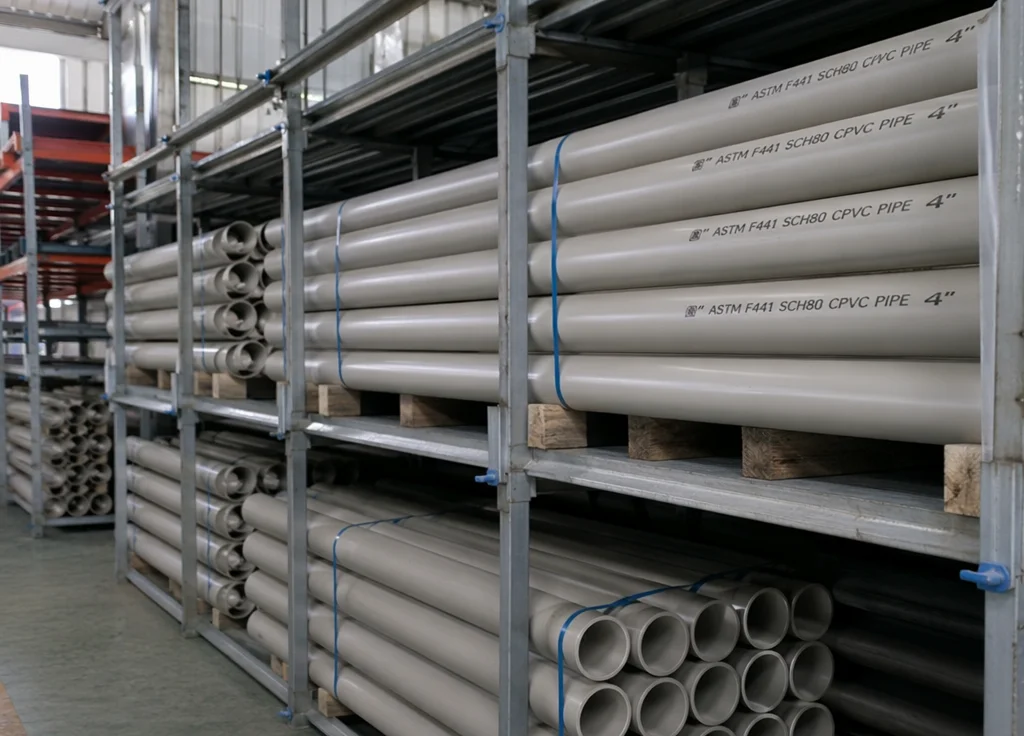
CPVC pipe standards depend on whether the application is hot water, industrial piping or chemical fluid transfer.4
| Application | Common Standards | Common Pressure Classes |
|---|---|---|
| Hot and cold water systems | ASTM D2846, CTS standards | Depends on size and temperature |
| Industrial chemical piping | ASTM F441/F441M | Schedule 40, Schedule 80 |
| Chemical liquid transfer | ASTM, ISO, DIN series | PN10, PN16, SCH80 |
| Fire sprinkler systems | Special certified CPVC fire sprinkler standards | According to system certification |
For industrial chemical systems, ASTM F441 Schedule 80 CPVC pipe is commonly used because of its stronger wall thickness and higher pressure capacity.
What pressure ratings are available for CPVC pipe?
Common CPVC pipe pressure options include PN10, PN16, Schedule 40 and Schedule 80.
Schedule 80 CPVC is often selected for industrial and chemical applications because it has a thicker wall than Schedule 40.
When selecting CPVC pressure rating, check:
- Working pressure
- Working temperature
- Medium concentration
- Pipe size
- Valve and fitting compatibility
- Safety factor
- Continuous operation conditions
CPVC pressure capacity decreases when temperature increases.5
This is one of the most important considerations in hot water and warm chemical liquid systems.
How to select CPVC pipe for different applications?
| Application Condition | CPVC Selection Advice |
|---|---|
| Hot water or warm water | CPVC is usually suitable |
| Warm acid or alkali wastewater | CPVC may be suitable after checking concentration |
| Electroplating or surface treatment lines | CPVC is often used for selected chemicals |
| Industrial circulating water | CPVC is suitable for higher temperature than PVC |
| Strong solvent system | CPVC is not recommended |
| High-concentration oxidizing acid | Use caution; PVDF or PTFE may be better |
| Acid and alkali wastewater with welded piping | PPH may be better |
| Strong corrosion and high-purity requirements | PVDF may be more suitable |
CPVC is often selected when PVC pipe temperature resistance is not enough.
If the system involves strong acids, high-purity fluids or demanding chemical conditions, PVDF pipe may be more suitable.
For welded acid and alkali wastewater systems, PPH pipe may also be considered.
Summary
CPVC pipe is suitable for:
Hot water, warm water, industrial circulating water, salt solutions, hydrochloric acid, low to medium concentration sulfuric acid, dilute nitric acid, dilute acetic acid, electroplating liquids, acid-alkali wastewater and surface treatment liquids.
CPVC pipe is not recommended for:
Acetone, benzene, acetaldehyde, methyl formate, nitrocellulose lacquer, aromatic hydrocarbons, ketones, esters, chlorinated solvents, high-concentration oxidizing acids and complex organic solvent mixtures.
CPVC is best positioned as a medium-temperature plastic pipe material for hot water, chemical wastewater, electroplating systems and industrial water treatment.
"[PDF] Chemical Compatibility of CPVC", https://www.cfm.va.gov/til/dManual/ChemicalCompatibility.pdf. CPVC pipe is widely used in industrial applications due to its chemical resistance and temperature tolerance, as noted in engineering materials studies. Evidence role: general_support; source type: education. Supports: CPVC pipe is commonly used in hot water systems, chemical transfer, and wastewater treatment.. ↩
"[PDF] Chemical Compatibility of CPVC", https://www.cfm.va.gov/til/dManual/ChemicalCompatibility.pdf. Chemical compatibility charts from material science institutions confirm CPVC's resistance to these media. Evidence role: expert_consensus; source type: institution. Supports: CPVC pipes are suitable for handling hot water, salt solutions, and low to medium concentration acids and alkalis.. Scope note: Specific concentration limits should be verified for each application. ↩
"CPVC vs. PVDF - MakeItFrom.com", https://www.makeitfrom.com/compare/Chlorinated-Polyvinyl-Chloride-CPVC-PVC-C/Polyvinylidene-Fluoride-PVDF. Material selection guides recommend CPVC for applications where PVC fails and PVDF exceeds requirements. Evidence role: expert_consensus; source type: education. Supports: CPVC is often selected for applications requiring moderate heat resistance and chemical compatibility.. Scope note: Specific application needs may alter material choice. ↩
"[PDF] Chemical Resistance and Chemical Applications for CPVC Pipe and ...", https://www.nrc.gov/docs/ML1820/ML18207A604.pdf. Government and industry standards specify CPVC requirements for various applications. Evidence role: definition; source type: government. Supports: CPVC pipe standards differ based on application, such as ASTM F441 for industrial piping.. Scope note: Regional standards may differ. ↩
"Corzan® CPVC Pipe Pressure Ratings", https://www.corzan.com/en-us/specification/pressure-ratings. Material studies show CPVC's pressure rating drops significantly at higher temperatures. Evidence role: mechanism; source type: research. Supports: CPVC pipe's pressure capacity decreases as temperature rises.. Scope note: Exact values depend on pipe grade and manufacturer. ↩