Pipe S value calculation often causes confusion because S6.3, S4, and S10 do not state pressure directly. If a buyer treats these markings as universal PN ratings, the selected pipe may have the wrong wall thickness or service capacity. I use the S series, material design stress, dimensions, and applicable standard together to evaluate a pipe correctly.
S6.3, S4, and S10 are plastic pipe series designations based on the relationship between outside diameter and wall thickness. A lower pipe S value indicates a thicker wall for the same outside diameter. Pressure rating depends on the pipe series, material strength, design coefficient, temperature, intended service life, and governing product standard.
The key is to separate three related terms: S series, SDR, and PN. They describe pipe geometry and pressure performance from different angles. Once I connect the formulas, I can compare quotations, verify technical data, and identify specifications that require clarification before procurement.
What Do Pipe S6.3, S4 and S10 Mean?
The markings S6.3, S4, and S10 can look like pressure classes, but that interpretation creates a procurement risk. A buyer may assume that S4 always means the same PN across PVC, PP-R, CPVC, or PVDF systems. In reality, these designations primarily describe pipe dimensions.
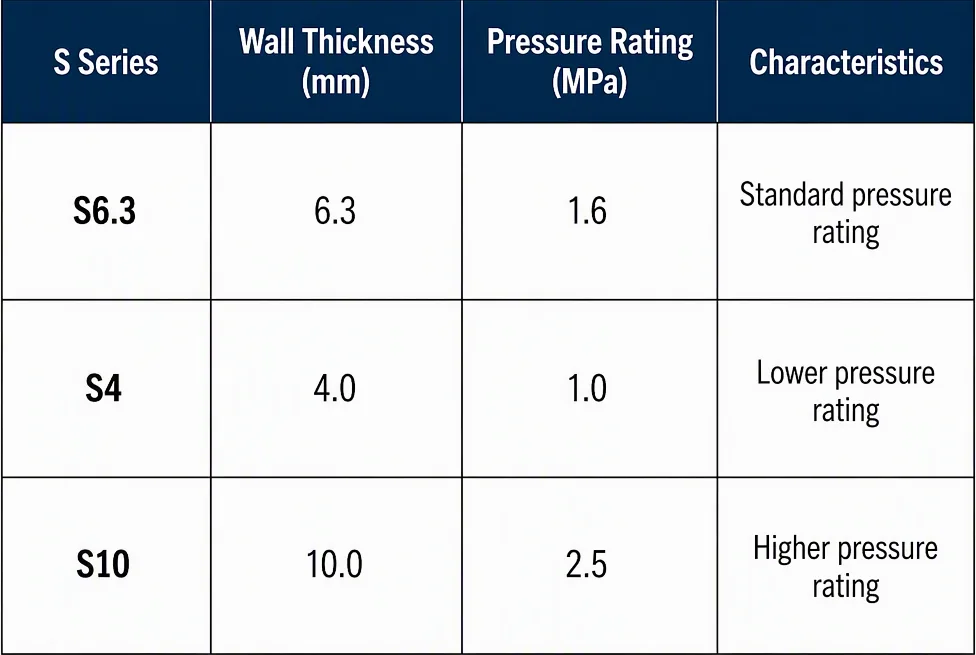
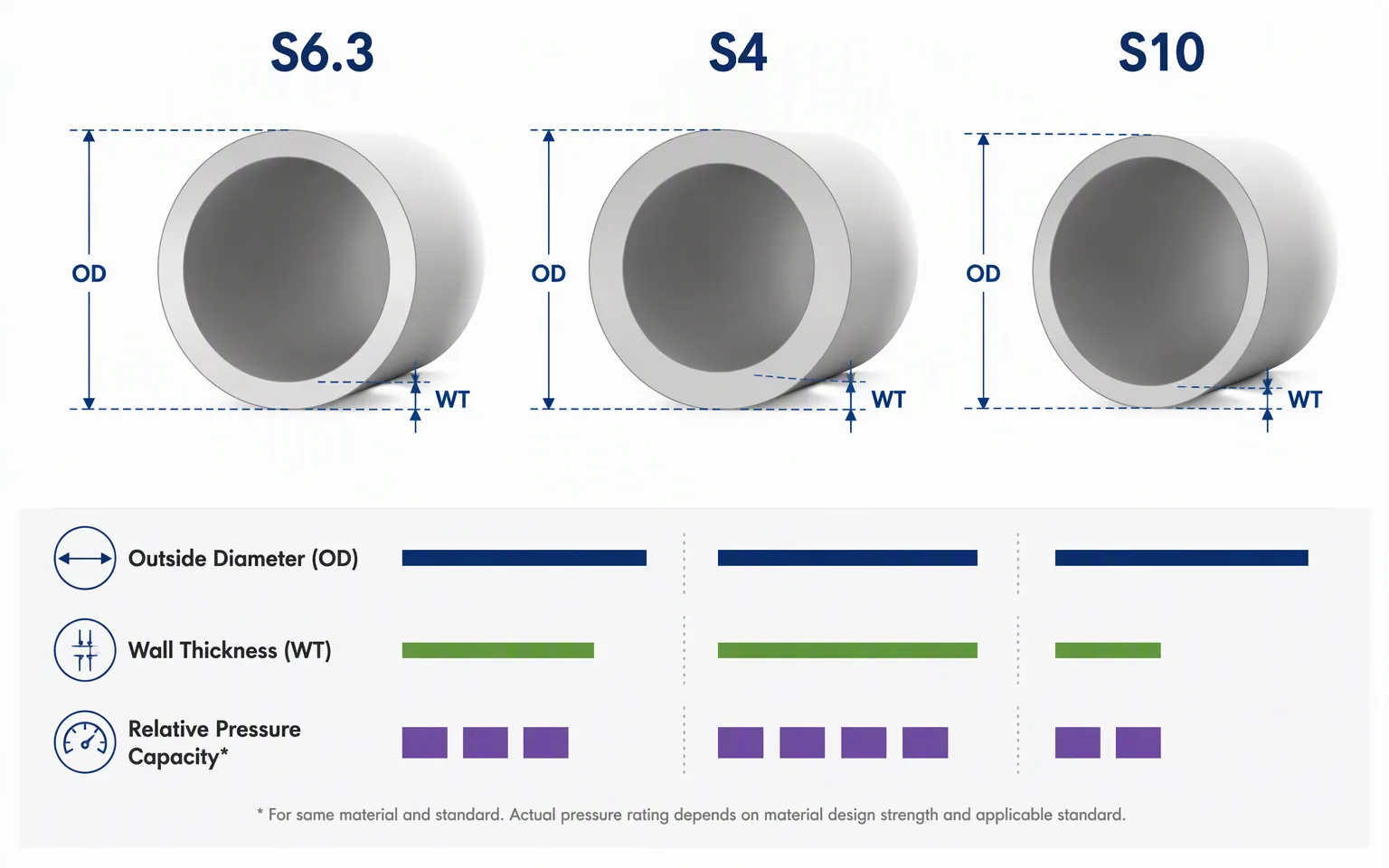
Pipe S6.3, S4, and S10 identify standardized relationships between nominal outside diameter and nominal wall thickness. For pipes with the same outside diameter, S4 has a thicker wall than S6.3, while S10 has the thinnest wall. However, the final pressure rating still depends on material design strength and the applicable standard.
The basic meaning of a pipe S value
The pipe series number comes from the following dimensional relationship:
[
S = \frac{d_n - e_n}{2e_n}1
]
Where:
- (S) is the pipe series value.
- (d_n) is the nominal outside diameter.
- (e_n) is the nominal wall thickness.
The equation shows why a smaller S value means a thicker pipe wall. When the outside diameter remains constant, increasing wall thickness reduces the calculated S value.
I usually explain the three series in simple commercial terms:
| Pipe series | Corresponding SDR | Relative wall thickness | General pressure potential |
|---|---|---|---|
| S4 | SDR 9 | Thickest of the three | Highest, if material and conditions are equal |
| S6.3 | SDR 13.6 | Intermediate | Medium |
| S10 | SDR 21 | Thinnest of the three | Lowest |
This comparison does not create a universal PN table. It only shows the relative effect of wall thickness under otherwise equal conditions.
For example, an S4 PP-R pipe and an S4 PVDF pipe share a similar dimensional ratio, but they do not automatically have the same operating pressure, temperature resistance, or chemical compatibility. Their material properties and product standards differ.
Why buyers encounter different S markings
S series markings are common in thermoplastic piping standards and specifications. Buyers may see them in documents for:
- Building water supply systems
- Agricultural irrigation networks
- Industrial water treatment
- Chemical liquid handling
- Municipal water distribution
- Compressed-air applications permitted by a specific standard
- Hot- and cold-water installations
I have seen quotations where the supplier listed only “S4 pipe” without stating the material grade, standard, or PN rating. That description was not enough for a technical comparison. I asked for the full dimensional table and pressure basis before treating the offer as compliant.
Procurement point: I treat the pipe S value as a geometry designation, not as a stand-alone guarantee of allowable working pressure.
How Is the Pipe S Value Calculated?
A specification can include a pipe S value that appears precise while the quoted wall thickness does not match it. This mismatch may come from rounding, a different dimensional standard, or an incorrect quotation. I calculate the theoretical value first and then compare it with the standard dimensional table.
The pipe S value is calculated by subtracting nominal wall thickness from nominal outside diameter and dividing the result by twice the nominal wall thickness: (S=(d_n-e_n)/(2e_n)). The relationship can also be rearranged as (e_n=d_n/(2S+1)) for preliminary wall-thickness calculations.
Example 1: Calculating S from pipe dimensions
Suppose a plastic pipe has:
- Nominal outside diameter: 90 mm
- Nominal wall thickness: 10 mm
The calculation is:
[
S = \frac{90-10}{2 \times 10}
]
[
S = \frac{80}{20} = 4
]
The theoretical pipe series is therefore S4.
This example also corresponds to SDR 9 because:
[
SDR = \frac{90}{10} = 9
]
Example 2: Estimating wall thickness from S
Suppose a specification calls for an outside diameter of 110 mm and an S value of 10. The theoretical nominal wall thickness is:
[
e_n = \frac{d_n}{2S+1}
]
[
e_n = \frac{110}{21} = 5.24\text{ mm}
]
The standard table may list a nearby standardized minimum or nominal thickness, such as 5.3 mm, depending on the product standard and its rounding rules. I would not alter a purchase specification based only on the calculated 5.24 mm result. I would check the exact size table in the referenced standard.
Theoretical dimensions versus standard dimensions
The formula gives a mathematical relationship, but manufacturers produce pipes according to standardized values and tolerances. These factors can affect the final published dimension:
- Preferred number rounding: Standards use established dimensional series rather than unlimited decimal values.
- Minimum wall thickness: Some documents specify a minimum wall rather than a simple average measurement.
- Manufacturing tolerances: Extrusion processes require permitted dimensional ranges.
- Material-specific rules: Different thermoplastic standards can use different tolerances.
- Barrier or multilayer construction: Some layers may not contribute equally to pressure resistance.
- Fitting compatibility: The pipe must remain compatible with sockets, valves, unions, and joining systems.
I recommend measuring samples at several points around the circumference and along the pipe length. A single caliper reading cannot establish dimensional conformity. Incoming inspection should follow the sampling method and measurement procedure stated in the relevant standard.
The procurement document should clearly list:
- Material and material grade
- Nominal outside diameter
- Nominal wall thickness
- Pipe series or SDR
- PN designation, if applicable
- Product standard and edition
- Service temperature
- Intended fluid
- Required test documents
This information creates a much stronger basis for comparison than an S value alone.
How Does Pipe S Value Relate to SDR?
S and SDR often appear in the same technical discussion, which makes them seem like competing classification systems. They are actually direct mathematical equivalents. I use the conversion to check whether a supplier’s datasheet is internally consistent.
The pipe S value and standard dimension ratio are connected by the formula (SDR=2S+1). Therefore, S4 equals SDR 9, S6.3 equals SDR 13.6, and S10 equals SDR 21.2 A lower S or SDR indicates a thicker wall relative to outside diameter.
The S-to-SDR conversion
SDR is calculated as:
[
SDR = \frac{d_n}{e_n}
]
The pipe S value formula is:
[
S = \frac{d_n-e_n}{2e_n}
]
When the formulas are combined:
[
SDR = 2S+1
]
The conversion works in both directions:
[
S = \frac{SDR-1}{2}
]
Common conversions include:
| S series | Calculation | SDR |
|---|---|---|
| S2.5 | (2 \times 2.5+1) | 6 |
| S3.2 | (2 \times 3.2+1) | 7.4 |
| S4 | (2 \times 4+1) | 9 |
| S5 | (2 \times 5+1) | 11 |
| S6.3 | (2 \times 6.3+1) | 13.6 |
| S8 | (2 \times 8+1) | 17 |
| S10 | (2 \times 10+1) | 21 |
Why both terms appear in international sourcing
Different markets and standards favor different terminology. European and Asian specifications may use pipe series designations more often, while other commercial documents emphasize SDR. International tenders may include both.
The conversion helps me identify several common problems:
- A datasheet lists S4 but shows SDR 11.
- A quotation claims S10 but provides S6.3 wall dimensions.
- A supplier changes the SDR without updating the pressure class.
- A fitting series does not match the proposed pipe dimensions.
- An OEM label includes a customer-requested PN mark that lacks technical support.
S4 must correspond to SDR 9 as a dimensional relationship. If the dimensional table gives another ratio, I would ask the supplier to explain whether rounding, multilayer construction, or a documentation error caused the discrepancy.
S and SDR do not define every product dimension
The ratio does not establish all details needed for purchasing. It does not specify:
- Pipe length
- Socket dimensions
- Ovality limits
- Wall-thickness tolerance
- End preparation
- Color or UV stabilization
- Material formulation
- Joining method
- Temperature derating
- Long-term hydrostatic strength
For example, two pipes can both be SDR 13.6 while using different polymers. One may suit cold potable water, while another may be intended for chemical processing. The same ratio does not make them interchangeable.
I once reviewed two offers that both described an SDR 21 pipe. One quotation included the material designation and referenced test method. The other listed only diameter, color, and price. The ratios matched, but the technical confidence did not. The more complete offer gave the buyer a better basis for supplier qualification.
How Do Pipe S6.3, S4 and S10 Relate to PN Ratings?
A common sales shortcut assigns one PN value to each S series. That shortcut can be misleading because pressure capacity comes from both geometry and material performance. Temperature, design life, and safety factors also affect the allowable pressure.
The PN rating can be estimated from (PN=\sigma_s/S)3, where (\sigma_s) is the material design stress in MPa and S is the pipe series. Consequently, the same S value can produce different pressure ratings for different materials or standards. The declared PN must be verified against the governing product standard.
The pressure relationship
For a simple thermoplastic pressure-pipe model, circumferential or hoop stress can be expressed as:
[
\sigma = P \times S
]
The pressure relationship is therefore:
[
P = \frac{\sigma}{S}
]
For design purposes, material design stress may be derived from:
[
\sigma_s = \frac{MRS}{C}
]
Where:
- (MRS) is the minimum required strength.
- (C) is an overall design or service coefficient.
- (\sigma_s) is the allowable design stress.
- (P) or (PN) is expressed in MPa when stress is expressed in MPa.
The exact terminology and permitted values depend on the product standard. Buyers should not select the coefficient independently without qualified engineering review.
Why one S series can have different PN values
The following examples use hypothetical design stresses to show the effect. They are not universal product ratings.
| Pipe series | PN at 6.3 MPa design stress | PN at 8.0 MPa design stress |
|---|---|---|
| S4 | 1.575 MPa | 2.00 MPa |
| S6.3 | 1.00 MPa | 1.27 MPa |
| S10 | 0.63 MPa | 0.80 MPa |
If a material standard uses an allowable design stress near 6.3 MPa, S4 may correspond approximately to PN1.6, S6.3 to PN1.0, and S10 to PN0.63. If the allowable stress changes, the PN result also changes.
This is why I do not approve a universal statement such as “S4 always equals PN1.6.” The statement may be correct for a particular material and standard, but it is not correct for every plastic piping system.
Temperature and service conditions matter
PN is normally associated with reference conditions defined by the applicable standard. Thermoplastic materials lose pressure capability as temperature rises. The design pressure may therefore require a derating factor.
A proper engineering review should consider:
- Maximum continuous operating temperature
- Short-term peak temperature
- Required service life
- Internal pressure cycles
- Water hammer or surge pressure
- Fluid chemical concentration
- External loads and burial conditions
- Joint type and fitting rating
- UV exposure
- Installation workmanship
The system rating is limited by its weakest pressure-containing component.4 A PN16 pipe connected to a lower-rated valve, union, or solvent-welded fitting does not create a PN16 system.
For project procurement, I ask the responsible engineer to approve operating conditions and pressure derating. The pipe manufacturer can provide material and test data, but application-specific suitability requires professional evaluation.
How Should Buyers Verify Pipe S Values and Pressure Claims?
A correct formula does not guarantee a consistently manufactured pipe. Resin selection, extrusion control, dimensions, testing, and traceability affect procurement quality. I therefore evaluate both the technical specification and the supplier’s ability to reproduce it at scale.
Buyers should verify pipe S values by checking outside diameter, wall thickness, SDR, material designation, PN basis, and applicable standard. They should also review batch traceability, raw-material records, dimensional inspection, hydrostatic test evidence, and third-party documents. A production pressure test should not be treated as a substitute for long-term type testing.
A practical supplier-evaluation checklist
I recommend checking the following items before approving an order:
Referenced standard
The quotation should state the standard and, when relevant, its edition. DIN, ISO, ASTM, BS, JIS, and national standards may use different dimensions or test requirements.Material identification
The supplier should state whether the product is PVC-U, CPVC, PP-H, PP-R, PPR, PPH, PVDF, or another material. A generic label such as “plastic pipe” is inadequate.Material traceability
Buyers should request batch records and resin documentation. For our own manufacturing context, we state the use of 100% virgin material, but buyers should still verify that claim through agreed records, inspection, or testing.Dimensional control
The inspection report should include outside diameter, wall thickness, ovality, and length. The results should match the declared pipe S value or SDR.Pressure-test basis
The supplier should distinguish between routine production testing, batch testing, and long-term hydrostatic type testing.System compatibility
Pipes, valves, and fittings should follow compatible standards and joining dimensions.Marking and traceability
Pipe marking should identify the manufacturer, material, size, series or SDR, pressure class where required, standard, and production code.
How I interpret pressure testing
Our business context includes 100% pressure testing as a quality-control measure for applicable pressure-containing products. This process can help detect assembly leaks and short-term defects. However, I still explain the test method, duration, medium, and acceptance criteria to buyers.
Short-term factory pressure testing cannot prove a 50-year service life by itself.5 Long-term performance requires material qualification and hydrostatic testing conducted under the relevant standard. Buyers should request the actual report rather than rely only on a statement such as “pressure tested.”
How I treat certificates
Documents such as ISO 9001, CE-related declarations, REACH documentation, SGS reports, and BV inspection reports can support supplier evaluation. However, each document has a defined scope.
I recommend verifying:
- Issuing body
- Certificate number
- Validity dates
- Legal manufacturer name
- Factory address
- Covered products
- Referenced standard
- Report sample details
- Whether the document is a certificate, declaration, or test report
A valid ISO 9001 certificate addresses the quality management system. It does not automatically certify every pipe size or pressure rating. Similarly, a third-party report applies to the tested samples and specified test conditions.
Sample approval before mass production
For large distribution or project orders, I suggest a controlled approval process:
- Confirm the signed specification.
- Approve pre-production samples.
- Measure critical dimensions.
- Review markings and packaging.
- Check joint compatibility.
- Witness or review pressure tests.
- Define batch sampling.
- Keep approved samples for comparison.
This process matters when a supplier provides OEM or ODM services, including custom laser marking, packaging, color, or mold development. Custom branding should never replace the technical markings needed for traceability and safe system selection.
Frequently Asked Questions
Is S4 stronger than S6.3 or S10?
S4 has a thicker wall than S6.3 or S10 when the pipes have the same outside diameter. It therefore has greater pressure potential under equal material and temperature conditions. However, the actual strength and PN rating still depend on material properties, manufacturing quality, and the applicable product standard.
Does S6.3 always mean PN10?
No. S6.3 may correspond to approximately PN1.0 MPa, or PN10 bar, when the applicable design stress is 6.3 MPa. Another material or standard may produce a different rating. I verify the material design stress, temperature basis, and governing standard before accepting the PN designation.
What is the SDR of an S10 pipe?
An S10 pipe corresponds to SDR 21. The conversion formula is (SDR=2S+1), so (2 \times 10+1=21). This ratio means the nominal outside diameter is approximately 21 times the nominal wall thickness, subject to standard rounding and dimensional tolerances.
Can wall thickness alone confirm a pipe’s pressure rating?
No. Wall thickness can confirm the dimensional series when combined with outside diameter, but it cannot establish pressure rating by itself. Material strength, design coefficient, temperature, service life, manufacturing quality, joining method, and product standard must also support the declared pressure class.
Should pipes and fittings have the same PN rating?
The complete system should meet the required design pressure, but matching PN labels alone may not prove compatibility. Buyers should verify material, dimensions, joining method, temperature derating, and fitting or valve ratings. The lowest-rated compatible component generally limits the assembled system’s allowable pressure.
Conclusion
The pipe S value calculation connects outside diameter, wall thickness, SDR, and pressure potential. S4 equals SDR 9, S6.3 equals SDR 13.6, and S10 equals SDR 21, but none of these series creates a universal PN rating. I always verify the material, design stress, temperature, standard, dimensions, and test basis together. For a project-specific review of PVC, CPVC, UPVC, PP, PPR, PPH, or PVDF pipes, valves, and fittings, contact our team with the required standard, size, fluid, temperature, and working pressure.
"Simulation Analysis of Limit Operating Specifications for ...", https://pmc.ncbi.nlm.nih.gov/articles/PMC8537700/. ISO 4065 defines the thermoplastics pipe-series relationship using nominal outside diameter and nominal wall thickness, providing the standards basis for the stated S-value equation. Evidence role: definition; source type: institution. Supports: An international piping standard should define pipe series S in terms of nominal outside diameter and nominal wall thickness.. ↩
"Division 9 Materials - 2027 Standard Specifications M 41-10", https://wsdot.wa.gov/publications/manuals/fulltext/m41-10/division9.pdf. Applying the standardized SDR–S relationship gives S4 as SDR 9, S6.3 as SDR 13.6, and S10 as SDR 21. Evidence role: general_support; source type: institution. Supports: A dimensional reference should list or permit calculation of the three stated S-to-SDR correspondences.. Scope note: These equivalences describe dimensional ratios only and do not establish pressure class or material suitability. ↩
"Evaluating the Residual Stress and Its Effect on the Quasi ...", https://pmc.ncbi.nlm.nih.gov/articles/PMC9002702/. For homogeneous thermoplastic pressure pipe under the conventional thin-cylinder dimensional model, pressure is related to allowable circumferential design stress through the pipe-series ratio, yielding P = σs/S when consistent stress and pressure units are used. Evidence role: mechanism; source type: institution. Supports: A technical standard or engineering reference should derive nominal pressure from allowable circumferential design stress and pipe geometry.. Scope note: This simplified relationship does not by itself account for temperature derating, transient loads, joints, multilayer construction, or product-specific standard requirements. ↩
"6533. Pipe Lines, Fittings, and Valves.", https://www.dir.ca.gov/title8/6533.html. Piping design practice requires each pressure-containing component to be rated for the applicable design pressure and temperature; consequently, a lower-rated component constrains the allowable rating of the assembled system. Evidence role: expert_consensus; source type: government. Supports: A recognized piping-safety reference should state that all components must be suitable for the system design pressure and temperature.. Scope note: The final system rating also depends on joining quality, installation, loads, and any code-specific design allowances. ↩
"Pipe | Embedded Financial Solutions", https://pipe.com/. Long-term thermoplastic-pipe classifications use statistical extrapolation of hydrostatic stress-rupture data, commonly to a 50-year reference time, rather than treating a short factory pressure test as evidence of equivalent service duration. Evidence role: mechanism; source type: paper. Supports: A scholarly or standards-based source should explain how long-term hydrostatic performance is extrapolated from multi-temperature test data rather than inferred from one brief proof test.. Scope note: A 50-year classification is a standardized design projection under specified conditions, not a guarantee of field life in every installation. ↩